marketingwithmonika.com

Uncategorized

Uncategorized

How a Well-Structured Site Map Can Improve Your SEO Strategy

How a Well-Structured Site Map Can Improve Your SEO Strategy In the ever-evolving world of digital marketing, search engine optimization (SEO) remains a cornerstone for online success. While many businesses focus on keywords, backlinks, and content quality, one crucial element often overlooked is a Well-Structured Site Map. This foundational component can significantly impact how search engines crawl, index, and rank your website. In this blog, we’ll explore how a Well-Structured Site Map enhances your SEO strategy, improves user experience, and boosts your website’s visibility in search engine results. What Is a Well-Structured Site Map? A Well-Structured Site Map is a blueprint of your website that outlines its structure, pages, and hierarchy. It helps search engines like Google understand how your content is organized and ensures that all important pages are easily discoverable. There are two main types of sitemaps: When your website includes a properly organized sitemap, it becomes easier for both users and search engines to find relevant content without confusion. Why a Well-Structured Site Map Matters for SEO A Well-Structured Site Map plays a vital role in improving your SEO performance. It acts as a roadmap that guides search engine bots through your website, ensuring that no important page is left behind. 1. Improves Crawlability Search engine bots rely on clear pathways to discover content. A structured sitemap ensures that all pages, including those buried deep within your site, are accessible. By implementing a Well-Structured Site Map, you make it easier for search engines to crawl your website efficiently. 2. Enhances Indexing Indexing is the process of storing your web pages in a search engine’s database. Without proper indexing, your pages won’t appear in search results. A well-planned sitemap helps search engines: This ensures your website stays relevant and visible in search rankings. 3. Boosts Website Visibility When search engines can easily understand your site structure, they are more likely to rank your pages higher. A Well-Structured Site Map improves your chances of appearing in search engine results pages (SERPs). Using a clear and organized sitemap is a best practice that contributes to better visibility and organic traffic growth. Key Elements of a Well-Structured Site Map To maximize the benefits of a Well-Structured Site Map, you need to ensure it includes the following elements: 1. Clear Hierarchy Your sitemap should reflect a logical structure: A structured sitemap ensures that this hierarchy is easy to follow for both users and search engines. 2. Relevant URLs Only Include only important and indexable pages. Avoid adding: A clean sitemap improves crawl efficiency and keeps your site organized. 3. Regular Updates Search engines prefer fresh content. Keep your sitemap updated whenever you: 4. Proper Formatting Use standard XML formatting for search engines. Ensure your Well-Structured Site Map is error-free and follows best practices. How a Well-Structured Site Map Improves User Experience SEO isn’t just about search engines—it’s also about users. A Well-Structured Site Map enhances user experience in several ways: Easy Navigation Visitors can quickly find what they’re looking for, reducing bounce rates and increasing engagement. Better Accessibility A properly structured sitemap ensures that all important pages are reachable within a few clicks. Improved Retention When users can navigate easily, they are more likely to stay longer on your site and explore more content. Best Practices for Creating a Well-Structured Site Map To build an effective Well-Structured Site Map, follow these proven strategies: 1. Keep It Simple Avoid overcomplicating your sitemap. It should be easy to understand and navigate. 2. Limit the Number of URLs Google recommends keeping each sitemap under 50,000 URLs. If needed, split into multiple files. 3. Use Canonical URLs Ensure that only the preferred version of each page is included in your sitemap. 4. Submit to Search Engines Once your sitemap is ready, submit it via: This helps search engines discover your sitemap faster. Common Mistakes to Avoid Even with the best intentions, mistakes can reduce the effectiveness of your Well-Structured Site Map. Including Non-Indexable Pages Avoid adding pages blocked by robots.txt or marked as “noindex.” Ignoring Updates An outdated sitemap can mislead search engines and hurt your rankings. Poor Structure A confusing hierarchy defeats the purpose of having a clear site structure. The Long-Term SEO Benefits Investing in a Well-Structured Site Map delivers long-term SEO benefits: It also strengthens your overall website architecture, making your SEO strategy more sustainable. Conclusion A Well-Structured Site Map is more than just a technical requirement—it’s a strategic asset for your SEO success. By improving crawlability, enhancing indexing, and providing a better user experience, it plays a crucial role in boosting your website’s performance. If you want to stay ahead in the competitive digital landscape, investing time and effort into creating a structured sitemap is essential. When done right, it can transform your website into a search engine-friendly platform that attracts, engages, and converts visitors effectively. Start optimizing your site today with a Well-Structured Site Map, and watch your SEO strategy reach new heights.
Social Media Marketing
Uncategorized

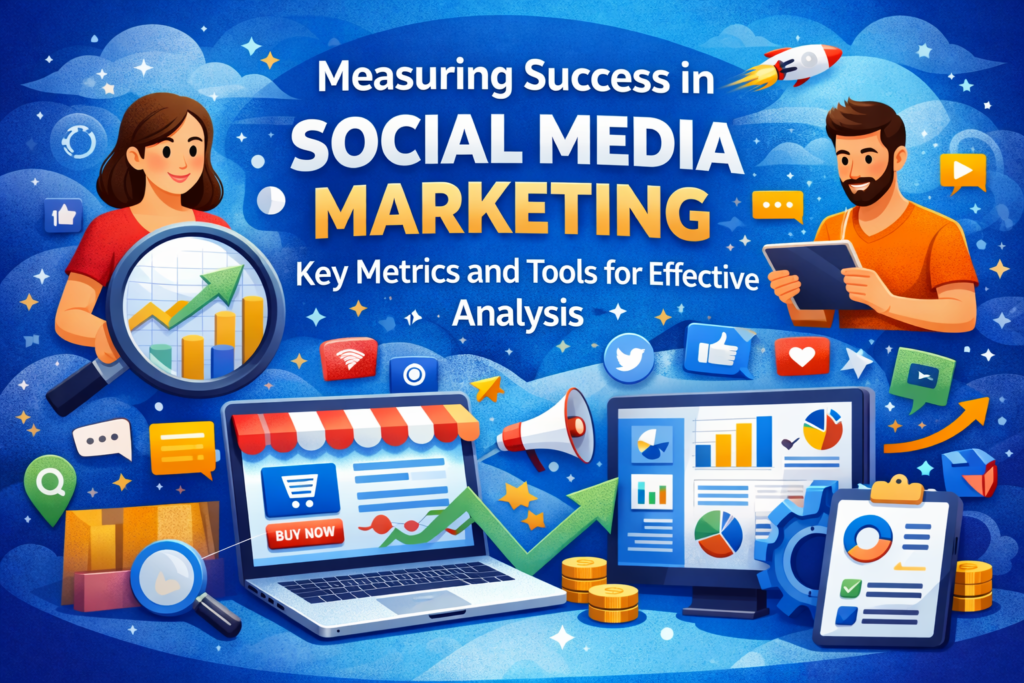
Measuring Success in Social Media Marketing: Key Metrics and Tools for Effective Analysis

Measuring Success in Social Media Marketing: Key Metrics and Tools for Effective Analysis In today’s digital-first business landscape, brands cannot rely on assumptions to grow online. Posting content regularly is not enough. Businesses must measure, analyze, and optimize their strategies to ensure consistent results. Measuring success in Social Media Marketing is essential for understanding performance, improving engagement, and driving measurable business growth. Without proper tracking, Social Media Marketing becomes reactive instead of strategic. From monitoring engagement levels to analyzing conversion data, companies must rely on performance metrics to maximize return on investment (ROI). This guide explores the most important key metrics and tools required for effective analysis and sustainable success. Why Measuring Social Media Marketing Performance Matters Every business invests time, creativity, and budget into Social Media Marketing campaigns. But how do you determine whether your strategy is actually delivering results? Tracking performance helps businesses: According to data published by Statista, global social media users exceed billions and continue to grow every year. With increasing competition, data-driven Social Media Marketing is no longer optional—it is a necessity. Key Metrics to Measure in Social Media Marketing To evaluate the effectiveness of Social Media Marketing, businesses must focus on measurable indicators that align with their goals. 1. Reach and Impressions Reach refers to the number of unique users who see your content, while impressions represent how many times the content is displayed. These metrics measure brand visibility. High reach suggests strong awareness, while impressions help assess content frequency. Platforms like Facebook and Instagram provide built-in dashboards to track these numbers effectively. 2. Engagement Rate Engagement is one of the most valuable indicators of successful Social Media Marketing. It includes: Engagement rate is calculated as: (Total Engagement ÷ Total Reach) × 100 A strong engagement rate signals that your content resonates with your audience. According to insights from HubSpot, engagement is often a more meaningful metric than follower count because it reflects active participation rather than passive visibility. 3. Click-Through Rate (CTR) CTR measures how many users click on your link after viewing your post or advertisement. Formula:CTR = (Clicks ÷ Impressions) × 100 A high CTR in Social Media Marketing indicates compelling copy, strong visuals, and clear calls-to-action (CTAs). 4. Conversion Rate Conversions represent meaningful actions such as: Tracking conversion rates helps businesses understand how Social Media Marketing contributes directly to revenue. Tools like Google Analytics allow marketers to track user journeys, behavior flow, and goal completions. You can learn more about conversion tracking from the official Google Analytics Help Center. 5. Follower Growth Rate While follower count alone is not a primary performance metric, steady audience growth indicates that your Social Media Marketing strategy is attracting interest and building brand authority. 6. Customer Acquisition Cost (CAC) CAC measures how much you spend to acquire a customer through paid and organic campaigns. Formula:Total Campaign Cost ÷ Number of Customers Acquired Lower acquisition costs combined with high conversion rates reflect efficient execution. 7. Return on Investment (ROI) ROI determines whether your efforts are profitable. Formula:(Revenue – Investment) ÷ Investment × 100 Positive ROI confirms that your Social Media Marketing strategy generates more revenue than it costs. For a deeper explanation of ROI, refer to Investopedia. Essential Tools for Measuring Social Media Marketing Success Manual tracking is inefficient. Modern tools simplify analytics and reporting. 1. Google Analytics Google Analytics is essential for tracking website traffic generated through Social Media Marketing. It provides insights into: It helps connect social activity with business outcomes. 2. Meta Business Suite Meta Business Suite offers in-depth performance data for Facebook and Instagram campaigns, including: It is particularly useful for brands heavily invested in Meta advertising. 3. LinkedIn Analytics LinkedIn provides performance data tailored to B2B campaigns, making it valuable for companies targeting professionals and decision-makers. 4. Hootsuite Hootsuite enables marketers to manage multiple platforms from a single dashboard. It supports scheduling, monitoring, and performance reporting across channels. 5. Sprout Social Sprout Social offers advanced reporting features and competitor benchmarking tools for comprehensive Social Media Marketing analysis. How to Build a Data-Driven Strategy Measuring performance only matters if insights lead to action. Follow these steps: 1. Define SMART Goals Examples: 2. Select Relevant KPIs Choose metrics aligned with your business objectives rather than focusing on vanity numbers. 3. Monitor Performance Consistently Weekly tracking allows early detection of performance shifts. 4. Optimize Based on Insights If engagement drops: If CTR decreases: Consistent optimization strengthens Social Media Marketing outcomes over time. Common Mistakes in Social Media Marketing Measurement Many businesses prioritize likes and follower counts without evaluating deeper metrics. While visibility matters, revenue-driving indicators are more important. Avoid these mistakes: According to Harvard Business Review, organizations that adopt analytics-driven marketing strategies significantly outperform competitors. The Future of Social Media Marketing Analytics As artificial intelligence continues to evolve, analytics will become increasingly predictive and automated. Emerging trends include: Businesses that leverage advanced Social Media Marketing analytics will gain a strong competitive edge in the digital marketplace. Conclusion Measuring success in Social Media Marketing is critical for long-term growth. By tracking key metrics such as engagement rate, CTR, conversion rate, CAC, and ROI, businesses can transform data into actionable insights. Using tools like Google Analytics, Meta Business Suite, and Hootsuite ensures accurate tracking and informed decisions. In today’s data-driven world, combining creativity with analytics is the key to maximizing the impact of Social Media Marketing and achieving sustainable business success.

Scroll to Top